
Ninety-eight percent of hotel owners have started using AI in some form. Only 32% say it’s embedded across most of their operations. That gap, documented in Wyndham’s 2026 Owner Trends Report, tells you more about the state of independent hospitality than almost any other number this year.
It’s not that the industry is unaware. Awareness isn’t the problem, and hasn’t been for some time. The problem is that most independent operators are stuck somewhere between acknowledging AI’s relevance and doing anything meaningful about it. And while they’ve been weighing options, the financial ground beneath them has been moving.
The Margin Squeeze Nobody Outran
For several years, rising demand gave hotels permission to push rates upward. That strategy masked a lot of operational inefficiency. By mid-2025, the cover was gone.
According to AHLA, gross operating profit per available room (GOPPAR) across the U.S. hotel industry still sits roughly 10% below 2019 levels, even though top-line revenue has broadly recovered. Hotels paid nearly $128 billion in wages and benefits in 2025, with that figure projected to reach $131 billion in 2026. Labour now accounts for between 43% and 60% of operating costs depending on the region, according to Cloudbeds’ data.
And then there’s distribution.
OTA share among independent properties climbed to 63.4% in 2025, up from 61.3% the previous year. In some markets (Portugal, Indonesia), it approaches 80%. Each of those intermediary bookings carries a commission of 15–25%, meaning nearly two-thirds of all revenue now passes through a tollbooth before it reaches the operator. From 2019 to 2025, global RevPAR rose 19%, but the cost of acquiring each booking increased 25%.
The instinct for most operators has been to try to grow their way out of this. Sell more rooms. Push rates. Fill the calendar. But the data is fairly clear: earning more hasn’t translated to keeping more. The question for 2026 isn’t really about selling more rooms. It’s about protecting the revenue you’re already generating. That reframe is precisely where AI becomes relevant; not as a growth hack, but as operational insulation.
The Adoption Gap Is Wider Than You’d Think
The standard narrative around AI in hospitality goes something like this: early adopters on one side, laggards on the other. But that framing oversimplifies what’s happening.
h2c GmbH’s global study of 171 hotel chains found that 78% have integrated AI solutions, and 89% plan to expand usage within two years. Sounds impressive. Except the average AI reliance score across those chains is just 4.7 out of 10, and only 6% have a company-wide AI strategy. The brands with the most resources are still figuring it out.
Now consider the independent side. A TakeUp survey of nearly 200 independent owners and managers found 79% view AI positively, but only 34% are actively seeking solutions. Over half still rely on manual seasonal price adjustments. Cloudbeds puts overall AI adoption among independents at around 41%, compared with close to 80% for branded chains.
The gap between chains and independents is real, but the more revealing gap is the one within the independent segment: between conviction and action. Almost everyone agrees this technology is important. Almost nobody has figured out how to deploy it with confidence.
Canary Technologies’ survey of 404 IT decision-makers helps explain why. When asked where AI would have the most immediate impact, 58% of respondents pointed to guest communications (phone, chat, messaging) as the top area. That’s a useful signal. It suggests the industry already knows where the opportunity is; it’s just struggling with how to get there.
What Restaurants Figured Out About Voice AI
The restaurant sector has been deploying voice AI at scale for longer than hotels, and the March 2026 QSR SmartChain report captures where things stand. Voice AI in restaurants has moved past the pilot phase into core operational infrastructure. The lessons are practical and transferable:
- Voice AI delivers measurable gains in labour efficiency, order accuracy, and guest sentiment when it’s treated as an operational shift rather than a tech upgrade.
- Deployment without clean data, clear workflows, or frontline buy-in “adds noise instead of value,” as the report puts it directly.
- The strongest operators use voice AI to reduce variability, freeing staff to focus on service and human connection rather than repetitive transactional tasks.
- 54% of diners are comfortable with AI being used to improve their experience, according to a HungerRush survey cited in the report.
- AI is not set-and-forget. It requires continuous tuning, governance, and human oversight, a point made by Presto’s CEO Krishna Gupta.
The parallels between the two industries are hard to miss. Both run on thin margins. Both face chronic staffing pressure. Both live or die on guest experience during high-volume windows. The difference is that restaurants have already stress-tested voice AI under real operational pressure, and the verdict is that it works when it’s implemented with intention.
If a restaurant can trust AI to take a £47 dinner order accurately during a Friday rush, what’s the argument against trusting it to handle a room enquiry at 11pm on a Tuesday?
The Revenue Leak Nobody’s Measuring
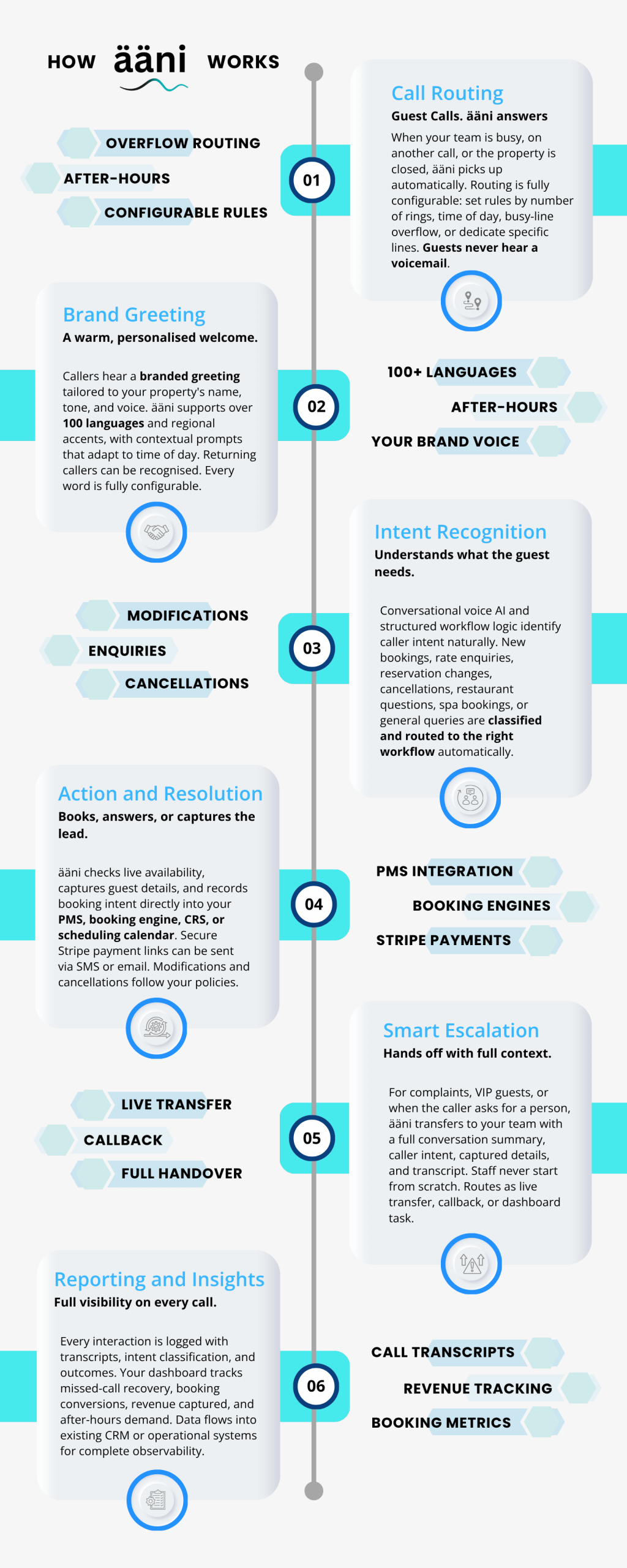
The phone remains one of the highest-intent channels a hotel has. When someone calls to ask about availability or rates, they’re far closer to a booking decision than someone browsing a website. And yet it’s the channel most likely to go unanswered.
Industry estimates put the figure at up to 40% of hotel calls missed during peak periods and shift changes. The consequences are immediate: 85% of callers won’t try again after an unanswered call, and 52% will turn to an OTA or a competitor to complete their booking.
PwC’s analysis provides the counterpoint. AI-supported reservation call centres show conversion rates 25–35% higher than traditional setups, with call abandonment dropping by 6–8%. Average handle time falls 15–25%, and overall call volume decreases 20–30% as routine queries are resolved without human intervention.
Meanwhile, AHLA reports that over 50% of U.S. hotels remain understaffed heading into 2026. Wages rose between 3.7% and 5.9% in 2025, and labour cost per occupied room climbed by 2–11.2%. When front desk teams are stretched across check-ins, guest requests, and administrative work, the phone is the first thing that gets deprioritised.
There’s an irony here that’s hard to ignore. Hotels invest significantly in digital marketing, SEO, metasearch, and social to push guests toward the point of enquiry. Then, at the moment of highest intent, when someone picks up the phone, nobody answers. The leak isn’t at the top of the funnel. It’s at the very bottom, where the money is.
From Awareness to Action