
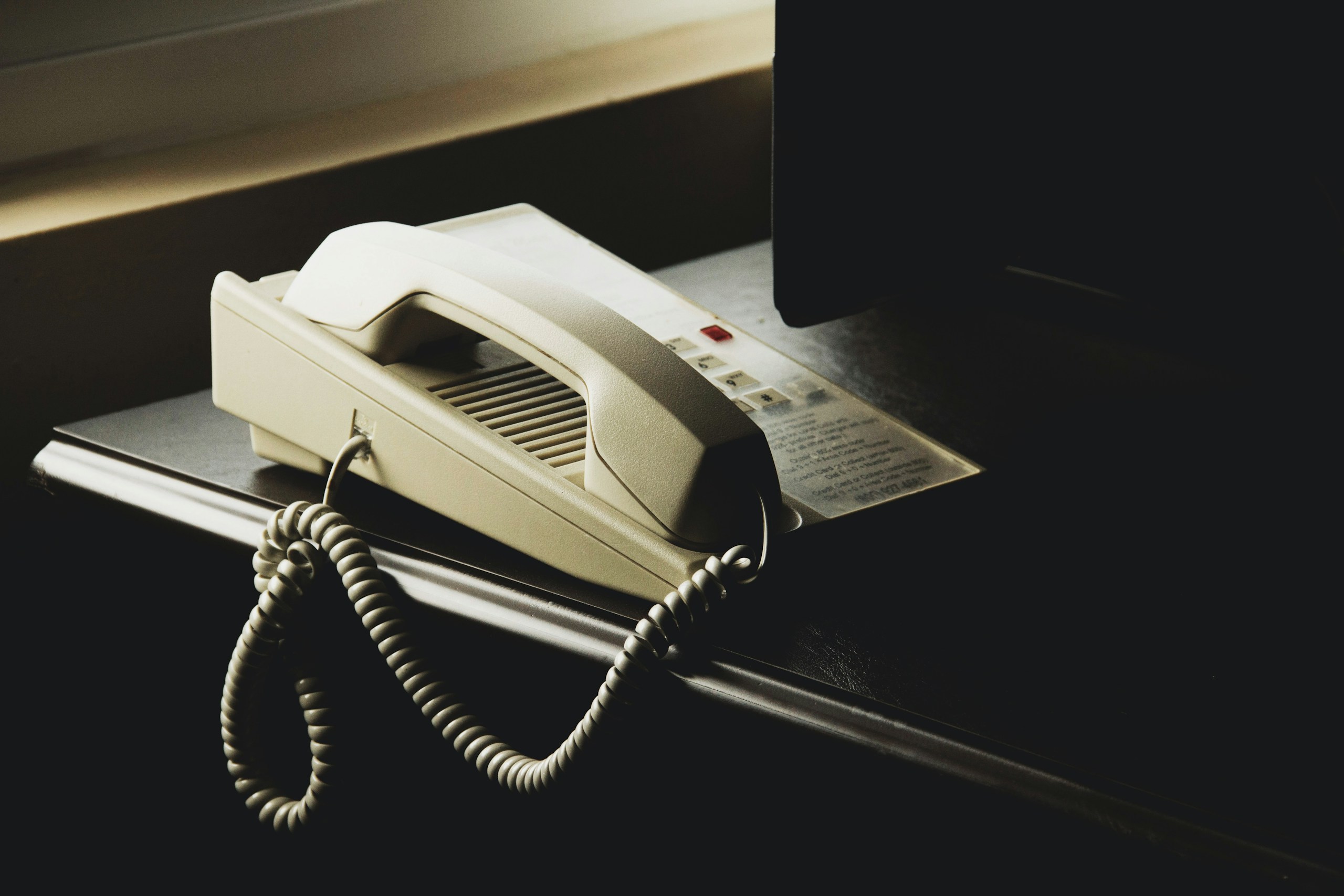
The ONS Vacancies and Jobs bulletin, May 2026 recorded UK hospitality vacancies at 69,000, a five-year low, with payrolled employees in accommodation and food services falling sharply through April. The phone keeps ringing anyway.
An unanswered phone in hospitality costs more than a missed booking. UK research shows phone is still the preferred contact channel for 31% of consumers, and that figure rises sharply with age. With sector vacancies at a five-year low, a missed call now signals understaffing to exactly the higher-spending, phone-preferring guests premium venues want.
What’s happening on those calls, who’s making them, when, and what they’re worth turns out to be more interesting than the usual missed-revenue headline.
The cost of a missed call in hospitality, in pounds and in patience
There isn’t a single number to put on a missed call, and any vendor that hands you one is selling you the answer they need you to hear.
The honest cost lives in the spread between the call that was answered well and the one that wasn’t. Revinate’s November 2025 analysis of hotel reservations agents found that 64% of guests don’t book on their first call, and that agents fail to ask for the booking 60% of the time. So even the calls that get answered are leaking revenue. The unanswered ones are simply the visible part of a wider answering-quality problem.
It’s worth remembering how recently the sector’s own representative body advised members to do less of this work, not more. In September 2023, UKHospitality told restaurants to train staff to redirect phone callers to online platforms, because reservations calls were taking up too much front-of-house time. It was reasonable advice for the moment. It just hasn’t aged well.
When the phone rings, and why no-one’s there to answer it
The missed call is, first, a staffing problem; then a technology one. Most coverage gets that order backwards.
Look at the labour data and the picture sharpens quickly. The ONS bulletin put hospitality vacancies at 69,000, down from an annual average of 162,000 across 2022. ONS Director of Economic Statistics Liz McKeown, quoted in CLH News on 19 May 2026, attributed the largest payroll falls directly to hospitality and retail. April alone saw payrolled employees drop by around 100,000 across the UK.
Then layer in turnover. Depending on which dataset you trust, UK hospitality is losing somewhere between 38.7% and 52% of its workforce every year; CIPD analysis sits at the top of that range, RotaCloud’s employer data at the bottom, per a May 2026 summary by Spoke & Stringer. YouGov polling in the same piece found 42% of staff leave within their first 30 days.
So the team is smaller, the team is newer, and it turns over before it’s learned the venue’s rhythm.
In that context, asking why the phone rings out at 7.45pm on a Saturday stops being a discipline question. The people who used to pick it up either aren’t there or are six tables deep on a service they’re covering short-handed. When the labour pool was deeper, answering every call was a training problem. It isn’t any more.
Why callers don’t leave voicemails any more
Here’s the part most missed-call conversations skip: the caller’s behaviour isn’t irrational. The research has been telling us that for twenty-five years.
Antonides, Verhoef and van Raaij’s 2000 field experiment at the Erasmus Research Institute of Management found that the disutility of waiting on a phone line follows a psychophysical power function. In plain English: the second minute hurts disproportionately more than the first, the third more than the second, and so on. Waiting isn’t priced linearly in the caller’s head. It accelerates.
A decade later, García and colleagues looked at 3,013 real call-centre interactions for their study, Waiting in Vain: Managing Time and Customer Satisfaction at Call Centers, published in 2012 and covered by the British Psychological Society Research Digest. Their conclusion was that actual queue time played a ‘significant but small role’ in satisfaction. What predicted satisfaction far better was the quality of information and service the caller received while waiting. As the authors put it, ‘a successful model is an informative satisfactory answer and top of the line service, even when queue times are large’.
Put those two findings next to each other and the implication for hospitality is uncomfortable.
A phone that rings out gives the caller no information, no acknowledgement, no expected wait. By the behavioural research, that’s the worst possible state of the call. It’s worse than a long hold with a clear update, worse than being told to wait two minutes for the duty manager. And the venue never sees the loss, because nothing about the call gets logged.
If the call that rings out is worse than the call that’s politely held, what does that say about how we’ve trained the front desk for the last twenty years?
Virtual receptionist, answering service and AI voice agents
These three products aren’t the same thing at three price points. They solve different problems and fail in different ways, so it pays to be precise about which one you’re comparing to what.
|
Option
|
Typical UK monthly cost
|
Available hours
|
Per-minute / per-call rate
|
Live diary / PMS access
|
Realistic fit
|
|---|---|---|---|---|---|
|
In-house front-desk cover
|
£2,500–£3,500 fully-loaded per FTE
|
Shift-bound; gaps at peak service and after-hours
|
n/a, fixed labour cost
|
Yes, full
|
Default; struggles during peaks and at 38.7%+ annual turnover
|
|
Human virtual receptionist or answering service
|
£100–£400 retainer
|
Often 24/7, capped minutes
|
£0.85–£2.20 per minute typical UK range
|
No, or read-only via shared screen
|
Useful for overflow and after-hours messages; brittle on actual bookings
|
|
AI voice agent (the ääni Voice category)
|
£200–£600 plus usage
|
24/7, topped up as and when needed
|
Per-call or per-minute, generally below human VA rates
|
Yes, live PMS and diary read-write
|
Best fit when calls need to complete (book, modify, upsell), not just be logged
|
What each option does well
In-house cover keeps the tone of the venue intact, because the person on the phone is the same person guests will meet later. Human answering services give you a polite, professional voice round the clock and a transcript by morning. An AI voice agent gives you something the other two can’t: the ability to finish the call: check live availability, take the booking, confirm an upsell, write back to the PMS.
What each option costs you when it’s the wrong fit
Human answering services charge per minute, which makes them most expensive on exactly the calls that convert, because those are the long ones. AI voice agents are weaker on genuinely unusual edge cases that need human judgement. And in-house cover, the most flexible option of the three, is also the most fragile to the staffing pressures already covered.
In practice, the choice isn’t usually one of these three. It’s a hybrid. The interesting design question is which calls go to which layer, not which vendor wins.
Is 24/7 answering worth it for an independent or boutique venue?
For a smaller, premium venue, the after-hours call is structurally the more valuable one. The caller is further along the decision; they’ve often already chosen you and are calling to confirm. They’re harder to recapture if you miss them.
YouGov Profiles, in an April 2025 deep dive on British customer service preferences, found that 65% of Britons regularly contact businesses by phone, and that phone is the top-preferred contact channel for 31% of UK adults overall. The figure climbs to 50% of the Silent Generation and 36% of Gen X; the cohorts with the most disposable income to spend on premium hospitality.
That’s a useful corrective to the assumption that you can route everyone to the booking form.
The staffing maths most operators don’t run
True 24/7 phone cover with people requires roughly 4.2 full-time equivalents, once you account for shifts, holiday, sickness and statutory rest. At £2,500 to £3,500 fully-loaded per FTE per month, you can do the rest of the arithmetic yourself. The honest conclusion is that the only practical way to deliver round-the-clock phone cover via people is to outsource it, and the moment you outsource it, you’ve also lost the in-house tone you were trying to protect.
The numbers change considerably when you’re balancing covers against cancellations rather than rooms against availability. If the after-hours caller is your highest-intent guest, why is the after-hours phone your least-resourced channel?
How guests truly feel about speaking to an AI on the phone
Guests are more open to AI than the hospitality industry tends to assume, and less trusting of it than the AI industry tends to assume. Both halves of that statement count, and a serious answer needs to hold them at the same time.
The Booking.com Global AI Sentiment Report, published 23 July 2025, surveyed 37,325 travellers across 33 markets, including 2,005 UK respondents, between April and May 2025. Two-thirds (67%) had already used AI somewhere in their travel journey. Nearly nine in ten (89%) wanted to use it in future planning. But only 6% said they fully trust AI, and 91% had at least one concern about its broader use.
That’s the baseline guests are bringing to your phone.
Now place it next to the bar your venue is being judged against. The Institute of Customer Service’s UKCSI for January 2026, based on 59,500 responses, scored Tourism at 81.3 out of 100; the highest the index has ever recorded for the sector. 83.2% of customer experiences were ‘right first time’ across the UK economy as a whole, also a record. 35.6% of customers now say they prefer excellent service even if it costs more, up 4.3 points year-on-year.
So guest openness to AI has risen at the same moment as guest expectations of service. The voice layer has to clear a higher bar than it would have done two years ago.
What that looks like in practice is reasonably specific:
-
A clear, early signal that the caller is speaking to an AI, not a person pretending to be one.
-
A live, accurate read on availability, rather than a ‘we’ll call you back’.
-
A clean handover to a person the moment the conversation moves outside the agent’s competence.
The dual truth in all of this is the useful argument. An AI voice agent that pretends to be a person fails one half of the data. An AI voice agent that handles the call so badly the guest wishes they’d got a person fails the other. The bar is competence with transparency, in that order.
The phone is still the front door
The unanswered phone is a symptom of three pressures arriving at the same time. The labour pool is thinner than it’s been in five years. The service-quality bar is the highest it’s been since the UKCSI began measuring. And the guest cohort that still prefers the phone hasn’t migrated off it; they’ve simply got older, wealthier and harder to win back when you miss them.
The reframing worth taking from all of this is that the phone is now the premium channel, not the legacy one. The web form is where price-sensitive guests self-serve. The phone is where the high-intent guest still expects to be met, especially after hours.
With vacancies at a five-year low and Booking.com’s data showing two-thirds of travellers already using AI somewhere in their journey, the question for premium venues isn’t whether the voice layer changes. It’s who gets to design what it sounds like. That design choice is what ääni Voice was built to give you control over.
FAQ
How much does a missed call really cost a hospitality business?
There isn’t a single figure, because it depends on your per-cover or per-room rate and how often the missed caller goes elsewhere. The more useful number is the spread between answered and unanswered calls. Revinate’s November 2025 data shows even answered hotel calls convert poorly, with 64% of guests not booking on their first call and agents failing to ask for the booking 60% of the time.
When are hospitality calls most likely to go unanswered?
At peak service and after-hours. The ONS Vacancies and Jobs bulletin, May 2026, showed UK hospitality vacancies at a five-year low, with payroll falls concentrated in accommodation and food services. Thinner teams collide with the moments callers most want to reach you: the run-up to evening service, weekends, and the windows immediately around close. Those gaps are structural, not a matter of staff discipline.
Do hospitality callers leave voicemails when no-one answers?
Most don’t. Behavioural research from Antonides, Verhoef and van Raaij at ERIM in 2000 shows the disutility of waiting accelerates non-linearly; the second minute on hold hurts disproportionately more than the first. Callers move on rather than wait or leave a message, and the venue rarely sees the loss because the missed call doesn’t get logged anywhere the team will review it later.
What’s the difference between a virtual receptionist, an answering service and an AI voice agent?
A human virtual receptionist or answering service takes calls and forwards messages, usually charging per minute. An AI voice agent like ääni Voice holds a live connection to your diary or PMS and can complete the booking on the call itself. The first logs the call so you can return it; the second resolves it while the caller is still on the line. Different products, different problems.
How do guests feel about speaking to an AI on the phone?
More open than the hospitality industry assumes. The Booking.com Global AI Sentiment Report, July 2025, surveyed 37,325 travellers across 33 markets and found 67% had already used AI somewhere in their travel journey, with 89% wanting to use it in future planning. Only 6% fully trust AI, though, so the practical bar is competence and transparency rather than a convincingly human voice.